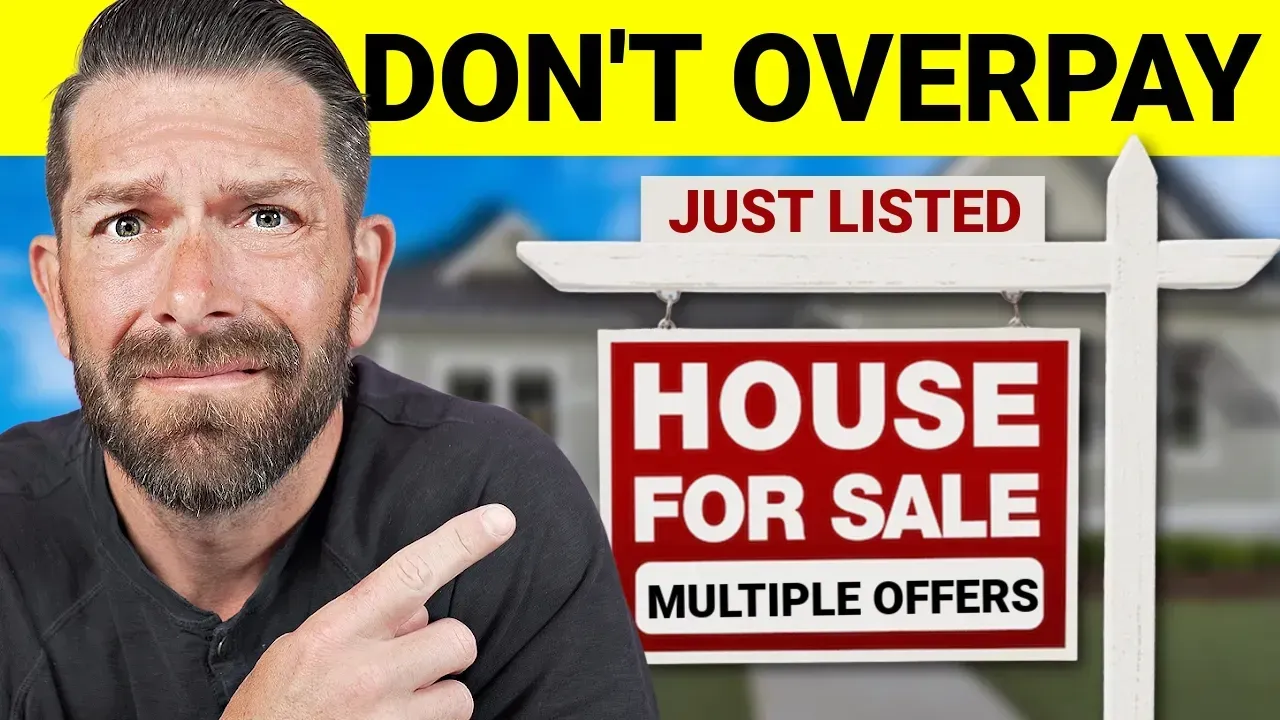
A lot of people think buying a home at a 6% mortgage rate is absolutely crazy. What if I told you it might be one of the smartest financial decisions you could make right now?
Over the past couple of years, a massive wave of buyers has hit the pause button. The logic goes something like this: I'll wait for interest rates to come down. I'll wait for home prices to drop. Then I'll jump in. It sounds reasonable on the surface. But that strategy has a serious flaw — and for buyers in Orange County and Huntington Beach, CA, it may be silently costing them far more than they realize.
This post breaks down why locking in your rate and buying now is financially sound, why the "wait for lower rates" approach often backfires, and what the current Southern California real estate market is actually telling us about where things are headed.
The Comparison Problem: Why 3% Rates Were the Anomaly, Not the Norm
People have very short memories when it comes to real estate. Right now, a huge portion of buyers are mentally anchored to two things: home prices before the pandemic, and interest rates at the bottom of the pandemic. That's the lens they're using to judge today's market — and it's creating a distorted picture.
Here's the reality. Those 2.5%, 3%, and 3.5% mortgage rates were not normal. They were the product of an extraordinary, once-in-a-generation event: a global pandemic that essentially shut down the world economy. In response, the Federal Reserve took the federal funds rate to zero. The government pumped trillions into the economy. Millions of Americans, locked at home with stimulus money coming in, were able to pay down debt, save for down payments, and shore up their finances in ways they never could before.
That was a black swan event. Those rates were a blip.
Zoom out further. From roughly 1982 to 2002, the United States was in a 40-year bull run for mortgage rates — meaning rates were generally trending down over that entire period. That trend broke in 2022 when the Fed began aggressively raising the federal funds rate to combat inflation. Rates shot up. The market felt the shock.
But here's the thing: if you pull back to a 50,000-foot view of interest rate history, today's 6% environment is not extreme. It's actually closer to the long-run average than those pandemic-era lows ever were.
The Personal Case Study: What Buying at 7% Actually Looked Like
In November 2023 — right around when 30-year fixed rates hit approximately 7.5%, the highest in over two decades — I closed on a $1.5 million property in my neighborhood. I secured a 7-year ARM at 7%. By many people's standards, that was the worst possible time to buy.
Online commenters were blunt about it. You're buying at the top of the market. You're locking in a sky-high rate. Why would you do that?
Here's why: it was the right time in my life. Five people in 1,700 square feet. Three growing boys. A specific property I'd wanted for years that finally became available. Those personal realities don't pause for market conditions.
And here's what happened next.
Before I even closed, rates had begun pulling back. I was able to do a no-cost refinance — zero out of pocket — and take my rate from 7% down to 6.5%, saving roughly $400 per month. About six months later, I did it again: 6.5% down to 6%, saving another $400 per month. Then more recently, I refinanced again to a 5.125% on a 7-year fixed. That last one required about $5,000–$6,000 in closing costs out of pocket — but the monthly savings were over $630, putting the break-even point at roughly 8 months. From that point forward, every month is pure savings.
All told, my monthly payment is now more than $1,400 lower than when I first closed — while the value of the property has increased somewhere between $100,000 and $150,000 during that same window.
You can never refinance the purchase price of a home. But you can refinance the payment — if and when rates move in your favor. That asymmetry is one of the most overlooked advantages in real estate.
The Core Strategy: Lock the Price, Float the Rate
This is the central idea that separates buyers who build wealth from those who stay on the sidelines waiting for a "perfect" moment that rarely arrives.
When you buy a home today, you lock in the purchase price. That price is fixed. It doesn't change if rates go up, if inventory tightens, or if five million more buyers enter the market next year. You own it at today's number.
The interest rate is a different story. If rates go down, you refinance. If you bought at 6% and rates fall to 5%, you don't miss out — you just refinance and capture the lower payment. You didn't need to have timed the market perfectly. You just needed to be in the game.
On the other hand, if you wait for rates to drop and they eventually do, here's what often happens simultaneously: more buyers flood the market, inventory gets absorbed faster, and home prices rise in response. You might get the lower rate you wanted — but you're paying significantly more for the house itself. That higher purchase price also affects your property taxes — and unlike a mortgage rate, property taxes are not something you can refinance down later.
The No-Cost Refinance Strategy, Explained
A question that comes up constantly: how do you refinance with no money out of pocket?
It comes down to how mortgage pricing works. On any given day, there's a market rate — say 6%. If you accept a slightly higher rate than the best available, the lender typically offers a lender credit that can be applied directly toward your closing costs. By taking, say, 6.25% instead of 6%, you might receive enough in lender credits to cover the full cost of the refinance.
This strategy makes sense when you believe rates will continue to trend down. You're not taking the absolute lowest rate today because you expect to refinance again. You're keeping your cash in your pocket and positioning yourself to take advantage of each dip as it comes.
That said — this isn't a strategy to blindly chase. If you're late in your career, or refinancing in the future isn't likely due to income changes or other factors, it may make more sense to pay points and buy down the rate. Every situation is different. The key is being intentional about it.
Not Sure Which Strategy Makes Sense for Your Situation?
Whether you're buying, selling, or trying to make sense of what's happening in the Orange County and Huntington Beach market, this is exactly the kind of strategic conversation I have with clients every day.
Let's Talk — Reach Out HereWhy Waiting for Lower Rates May Be a Losing Strategy in Southern California
There's a tempting logic to the "wait and see" approach. But in a market like Orange County and Huntington Beach, where inventory has been structurally constrained for years, waiting carries its own set of serious risks.
Risk #1: Home Prices Keep Climbing
Here in Southern California, real estate competition is playing out in real time, right now. On offer after offer, buyers are going above asking price. Multiple-offer situations are the rule, not the exception. The next home to hit the market isn't necessarily listed higher than the last one, but it's selling above asking price just the same.
At the current pace of inflation — which sits around 2.5% on headline figures and could move toward 3% or higher depending on energy prices — home values are likely to at minimum keep pace with inflation. Even modest appreciation erodes the advantage of waiting for a rate that's a fraction of a percent lower.
Risk #2: Every Rate Drop Adds Millions of Buyers to the Market
This is one of the most important dynamics in real estate that buyers consistently underestimate. Research shows that for every 1% drop in mortgage rates, approximately 4 million additional buyers become qualified to purchase a home nationally. That doesn't mean all four million rush to the market simultaneously — but it does mean competition intensifies significantly the moment rates fall.
The buyers who are waiting on the sidelines right now don't disappear. They're just delayed. When rates finally move, they all come back to the market at once, competing for the same limited inventory — and driving prices up in the process.
Risk #3: Inflation Is Stickier Than Most People Expected
The path to significantly lower interest rates runs directly through inflation. The Federal Reserve has a stated target of 2% inflation. Until they see sustained progress toward that number, aggressive rate cuts are unlikely.
Several forces are keeping inflation stickier than anticipated: ongoing geopolitical conflicts affecting energy supply, tariff uncertainty, and the cascading effect of higher oil prices on everything from transportation to manufacturing to consumer goods. Oil feeds into virtually every sector of the economy. When oil prices rise, the cost of goods rises, and that inflation gets passed through to consumers. The Fed has signaled clearly that it's watching and waiting. Buyers waiting for materially lower rates may be waiting longer than they expect.
Risk #4: Supply Is Still Constrained — Especially in Southern California
There are certain markets — parts of Florida, Texas, Louisiana — where inventory has built up considerably and buyers have more leverage. Orange County and Huntington Beach are not those markets.
In Southern California, the housing supply shortage that existed before the pandemic was never meaningfully resolved. The lock-in effect — where homeowners with 2.5%–3% mortgages are reluctant to sell and give up their rates — has kept listings artificially low for years. Meanwhile, demand continues to be fueled by demographics: millions of Americans in their early-to-mid 30s are entering peak homebuying age every year, all competing for the same limited pool of homes.
Basic economics is clear on what happens when demand consistently outpaces supply: prices go up.
Renting Is Not a "Free" Alternative
One of the most persistent myths in the buy-vs.-rent debate is the idea that renting is the safe, neutral option while you wait for the perfect moment to buy. It's not neutral. It has real costs — and those costs compound over time.
Rent goes up. In most markets, rental increases run between 3% and 5% annually. And here's the part that often gets overlooked: when a landlord's insurance premium goes up, when their property taxes increase, when their maintenance costs rise — those costs don't stay with the landlord. They get passed directly to you in the form of higher rent at renewal.
Homeownership, by contrast, gives you the ability to fix the largest single component of your housing cost — your mortgage payment — for the life of your loan. A 30-year fixed mortgage at 6% today is still 6% in year 28. Your rent in year 28, if it's grown at even 3% annually, is roughly 2.3 times what it is today.
The earlier in life you can lock in a fixed housing payment, the more powerful that becomes. If you buy in your 20s or 30s — likely before your peak earning years — that payment becomes a progressively smaller portion of your income as your career advances. You've essentially front-loaded the hard part.
When Buying Makes Sense — and When It Doesn't
None of this is an argument that everyone should buy a home right now. There's a right time and a wrong time, and that line is different for every person.
Buying makes sense when:
- You have stability — in your job, your location, and your life
- You can comfortably make the payment even if rates never go lower
- You're planning to stay in the home for at least 5–7 years, ideally longer
- You have reserves in the bank beyond your down payment and closing costs
- The move makes sense for your life, not just your spreadsheet
That last point matters more than most people acknowledge. Buying a home at $1.5 million with a 7% rate made sense for my family because we needed more space and the right property became available. The financial math reinforced the decision — it didn't make it for me.
What doesn't make sense is buying at the absolute edge of what you can afford, banking entirely on the assumption that rates will fall and allow you to refinance into a comfortable payment. That's not a financial strategy. That's a bet — and it's one you shouldn't make with your home.
Buy with the expectation that if rates stay exactly where they are forever, you can still make this work. If rates fall and you can refinance, that's a bonus. Never make the refinance the requirement.
Don't Try to Time the Market
Timing the market perfectly is a fool's game in real estate, just as it is in equities. Even experienced professionals with decades of market knowledge get the timing wrong sometimes. The goal isn't to buy at the exact bottom. The goal is to buy at the right time in your life, with a clear understanding of the risks and a financial cushion to weather them.
What we know right now, in the current Southern California housing market:
- Inventory is limited and competition is fierce in Orange County and Huntington Beach
- Home prices are likely to at minimum track inflation going forward, and could move higher
- Interest rates are unlikely to fall dramatically in the near term given persistent inflation
- Every rate drop will bring more buyers off the sidelines, intensifying competition further
- Waiting does not reduce your risk — it simply changes the nature of it
When you buy today, you know exactly what you're getting: the price, the payment, the rate. Everything is defined. When you wait, you're betting on an unknown set of variables — where prices will be, where rates will be, whether your financial situation will be the same, whether the right property will even be available. That's a lot of uncertainty to take on voluntarily.
What Buying at 6% Actually Gives You
Let's be direct about what a purchase at today's rates actually provides:
- A locked purchase price — no one can take that away, regardless of what the market does next
- Forced savings through equity building — every payment chips away at the principal, building wealth you don't get from renting
- Appreciation upside — if home values increase 3% annually over five years, you're building equity on top of equity
- Rate optionality — if rates fall, you refinance. You don't lose that opportunity by buying now
- A hedge against rent inflation — your mortgage payment doesn't increase year over year the way rent does
- Potential tax advantages — mortgage interest deductions and other homeowner benefits renters don't access
And if rates move sideways — neither up nor down — you still win. You've locked in your payment, you're building equity, and home prices are very likely still appreciating modestly over time. If rates go up, you've protected yourself by locking in before the increase. If rates go down, you refinance and capture the savings.
The Bottom Line
A 6% mortgage rate is not a crisis. It is not a reason to stay on the sidelines indefinitely. It is a number — one that, in historical context, is entirely reasonable, and one that comes with the flexibility to improve over time if you approach it with the right strategy.
The buyers who will look back on this period with regret are not the ones who bought at 6% and later refinanced to 5% or lower. They're the ones who waited, watched prices climb, watched competition intensify, and finally bought later at a lower rate but a considerably higher price — often paying more in the long run for the privilege of patience.
Real estate has never been about perfect timing. It's about buying the right property, at the right time in your life, with a sound financial foundation underneath you. When those conditions are met, the rate is a variable — one you can work with over time.
If you're in Orange County, Huntington Beach, or anywhere in Southern California and you're genuinely evaluating whether now is the right time for you, run the actual numbers for your specific situation rather than relying on headlines. The calculus is almost always more nuanced — and more favorable — than the general narrative suggests.
Ready to Talk Strategy?
If you're weighing a purchase in Orange County or Huntington Beach — or you want to understand exactly what your numbers look like at today's rates — I'm happy to walk through it with you. No pressure, just a real conversation.
Get in Touch with Jeb SmithHuntington Beach homes for sale → link to your search/listings page
how to buy a home in Orange County → link to your buyer's guide or resources page
Southern California real estate strategy → link to a related blog post or service page
mortgage rates and home prices in Huntington Beach → link to a market trends post